Returns do not have to destroy your margins. 3PLCity receives, inspects, grades, and restocks customer returns from our Los Angeles fulfillment center — recovering up to 85% of return value as Grade A sellable inventory, eliminating returns backlogs, and giving you SKU-level visibility into why customers are returning so you can fix the source.

Return processing time
Average resellable rate
Return analytics
Return backlog
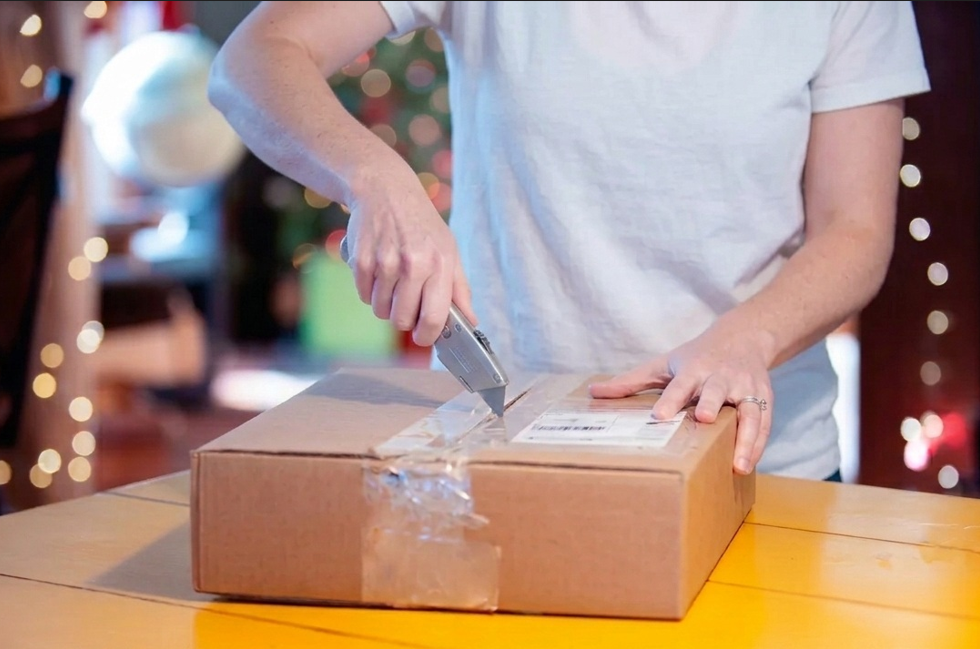
A streamlined six-step process turns every return into graded, dispositioned, and where possible — restocked inventory, with full visibility into every unit and the data to reduce return rates over time.

Your customer initiates a return and ships it back using a pre-paid return label that we generate on your behalf — embedded in your post-purchase emails, your branded RMA portal, or both. The label routes the return directly to our Los Angeles facility. Multi-carrier return labels supported across UPS, USPS, and FedEx based on customer location.

Returns arrive and are logged into our WMS within hours of delivery. Each unit is matched to the original customer order, original SKU, original ship date, and the return reason code the customer selected when they initiated the RMA. No returns sitting unidentified on the receiving dock for days — every unit accounted for as it arrives.

Trained inspection staff examine every returned unit against the original product spec — checking condition, completeness, original packaging, accessories, tags, seals, and any damages or defects. Photo documentation captured on request for damaged or disputed returns. Inspection notes recorded against the unit record for full audit trail.

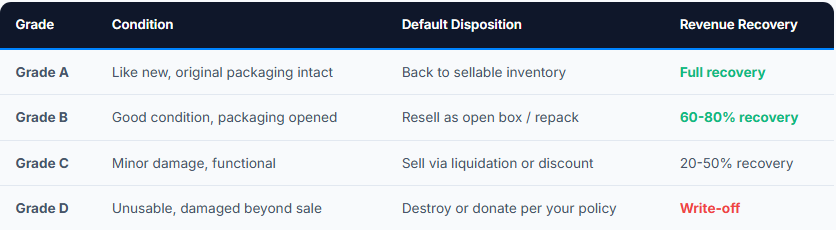
Every unit is assigned a quality grade against your standards: Grade A (sellable as new, original packaging intact, full recovery potential), Grade B (open box or refurb candidate with 60-80% recovery potential), Grade C (damaged but salvageable, 20-50% recovery via liquidation or discount channels), Grade D (unusable, destroy or donate per your policy).

Grade A units flow back into your sellable inventory automatically and update availability across every connected channel — Shopify, Amazon, TikTok Shop, Walmart, and wholesale. Grade B units are set aside per your standing instructions: relist as open box, ship to a liquidator, donate, or hold for review. Grade C and D units are quarantined or disposed per your direction with disposition documented per unit.

Real-time return dashboard tracking SKU-level return rates, reason code distribution, grade breakdown, recovery percentage, and trends over time. The data points to which products have fixable return drivers — sizing issues, photo quality, fit, defects, color accuracy, expectation mismatches — so you can reduce returns at the source instead of just processing them faster.
Purpose-built infrastructure, real-time technology, and hands-on service - all under one roof.
🔍
Every return inspected and graded A/B/C/D by trained staff who know your products and your quality standards. No guessing which returns are resellable, no margin lost to over-conservative write-offs, no Grade A units mistakenly sent to liquidation when they could have been restocked at full value.
💰
Grade A returns flow back into sellable inventory immediately, recovering up to 85% of return value that would otherwise be a permanent write-off. For brands with 20%+ return rates — typical in apparel and fashion — this represents tens of thousands of dollars per month in recovered revenue that competitors with weaker returns operations simply lose.
📊
SKU-level return rates, reason code analysis, and grade distribution reporting. Identify which products have fixable return drivers — wrong sizing charts, misleading photos, manufacturing defects, fit issues, color inaccuracy — and reduce returns at the source instead of processing them faster after the fact. The cheapest return is the one that never happens.
🔄
Grade A units scan back into sellable inventory automatically. Your Shopify, Amazon, TikTok Shop, Walmart, and other connected channels update without manual reconciliation, eliminating the inventory drift that plagues most returns operations. Restocked units available for sale within 24 hours of receipt.
👤
Optional branded RMA portal where customers initiate returns themselves — select reason, receive pre-paid label, ship it back. White-labeled with your logo, colors, and brand voice. Customers never see a third-party logistics interface, and the return experience reads as part of your brand instead of a third-party handoff.
📷
Photos of damaged, defective, or disputed returns available on request — supporting chargeback disputes, supplier claims, A-to-z claims on Amazon, PayPal disputes, and warranty cases. Evidence captured at receipt with timestamps, not reconstructed after the fact. The difference between winning and losing a $200 chargeback dispute is often a photo we already have.
Whether you process 5 returns a month or 500, our infrastructure scales with your return volume.
DTC brands with return rates above 10% who need professional inspection, grading, and restocking to recover inventory value instead of writing off every returned unit as a loss. Recovery economics improve dramatically once volume justifies a dedicated returns operation.
Fashion and footwear brands operating with 20-40% return rates where fast, accurate inspection and grading directly determines monthly margin and inventory turnover. Returns in fashion are not a problem to minimize — they are an inventory recovery operation to optimize.
Higher-value-item brands where detailed inspection separates fully resellable returns from cosmetically damaged units from defective product — and where photo documentation matters for chargebacks, A-to-z claims, and warranty cases. Even small recovery improvements translate to meaningful margin on higher-priced SKUs.
Sellers who want to control the return process themselves rather than letting Amazon dispose of FBA returns at a fraction of recovery value. We process returns from Amazon FBM, Shopify, Walmart, TikTok Shop, and any other channel from one operation — with channel-specific return reason tracking and chargeback defense documentation.
The average ecommerce return rate sits between 20% and 30%. For apparel, footwear, and fashion categories, it can climb above 40%. Without a professional returns process in place, returned products pile up on the receiving dock, inventory records drift away from physical reality, resellable units get lost in the shuffle, and you write off revenue you could have recovered. For a brand shipping $5M annually with a 25% return rate, that means $1.25M in product flowing back through returns every year — and the difference between a 60% recovery rate and an 85% recovery rate is $312,000 in recovered margin annually.
Professional returns management turns returns from a pure cost center into a revenue recovery function. 3PLCity grades every returned unit against your quality standards, restocks Grade A inventory the same day it arrives, and gives you SKU-level analytics to understand and reduce return rates over time — addressing the source of returns, not just the symptom. The cheapest return to process is the one that never happens, and the data we surface points your product, marketing, and customer service teams at the specific SKUs, sizing charts, photo issues, or quality defects driving returns in the first place.
Returns management is not just receiving packages. It requires trained inspection staff who know your products and your quality standards, a calibrated grading system applied consistently across every unit, WMS integration that updates inventory accurately across every connected channel in real time, photo documentation captured at receipt for chargeback and dispute defense, and analytics tools that surface return patterns at the SKU level instead of aggregating them away into useless summary statistics. Most generalist 3PLs treat returns as an afterthought to outbound fulfillment — staffing inspection with whoever has free time, inconsistent grading from week to week, inventory updates that lag by days, and zero return reason analysis.
3PLCity treats returns as their own discipline — staffed separately from outbound fulfillment, processed in the order they arrive without queue buildup, graded against documented client standards rather than picker judgment, and reported back to your team with the same urgency as inbound and outbound metrics. The workflow runs in the opposite direction from outbound fulfillment and demands different skills, different physical workflow, and different tooling — which is why we treat it as its own operation instead of bolting it onto pick-and-pack.
Every returned unit carries information your brand can use. The return reason code tells you why the customer returned it. The SKU, size, color, or variant tells you which product had the problem. The order date, ship date, and return date tell you whether the problem appeared at delivery, after first use, or weeks later. Aggregated across thousands of returns, this data reveals patterns: which sizes run small, which photos misrepresent the product, which colors look different on screen than in person, which manufacturing batches had defects, which carriers damage products in transit, which categories your sizing chart fails on.
3PLCity surfaces all of this data in your real-time dashboard, broken down by SKU, variant, return reason, and time period. Your product team sees which items have fixable defects, your marketing team sees which photos are setting wrong expectations, your customer service team sees which categories generate the most complaints, and your operations team sees which carriers cause the most in-transit damage. The brands that use this data to fix the root cause of returns see return rates drop 3-7 percentage points within 6 months — which translates to materially better unit economics across every order they ship, not just the ones that come back.
Returns received before 2 PM PST are processed the same business day. By end of day you will see the result in your dashboard — grade assigned, disposition recorded, and inventory updated where applicable. There is no returns backlog at our facility — units are processed in the order they arrive, not held in queue waiting for capacity. Workflow: receive and log against original order, inspect against product spec, grade A/B/C/D, execute disposition per standing instructions, update inventory across connected channels, photo documentation captured on request.
Yes. We provide a white-label RMA portal where customers initiate returns themselves — enter order number, select return reason from your custom reason code list, receive a pre-paid return label, and ship back. The portal is fully branded with your logo, colors, fonts, and brand voice — customers never see "3PLCity" anywhere in the experience. Pre-paid return labels embedded in your post-purchase emails, order confirmation pages, or both. Return shipping costs flow through transparently to your account at our negotiated carrier rates across UPS, USPS, and FedEx.
Your call. We follow standing instructions per grade: rebox and relist as open box for Grade B (typical 60-80% recovery), ship to a liquidator for Grade B/C (20-50% recovery via secondary markets), donate to charity, hold for your review, or destroy for Grade D unusable units. We document the disposition decision per unit so you have a full audit trail for accounting, tax write-offs, and supplier claims. Standing instructions can be set per SKU or per category if some products need different handling than others — for example, donate Grade B apparel but destroy Grade B beauty products for safety reasons.
We track return reasons by SKU at the unit level — sizing issues, defects, damaged in transit, not as described, changed mind, wrong item received, didn't fit, didn't match photos, allergic reaction, expired, broken on arrival. The data reveals which products have fixable return drivers (better size charts, better photos, packaging changes, quality control improvements at the supplier level) so you can reduce returns at the source rather than just processing them faster. Brands that act on the data typically see return rates drop 3-7 percentage points within 6 months.
Yes. We process returns from every channel you sell on — Shopify, Amazon FBM (we don't process FBA returns since Amazon handles those at their FCs), TikTok Shop, Walmart, BigCommerce, WooCommerce, Etsy, Squarespace, Wix, and wholesale B2B returns from retail accounts. Channel-specific return reason tracking and chargeback defense documentation maintained per channel. Multi-channel returns flow back to a single shared inventory pool, so a Grade A unit returned from Amazon becomes immediately available for sale on Shopify, TikTok, or any other connected channel.
The complete returns workflow: pre-paid return label generation, customer-facing branded RMA portal, inbound receiving and logging against original order, trained inspection against product spec, A/B/C/D grading per your quality standards, disposition execution per your standing instructions (restock, liquidate, donate, destroy), automated restocking of Grade A units back to sellable inventory across every connected channel, photo documentation of damaged or disputed returns, real-time SKU-level analytics on return rate and reason codes, and chargeback defense documentation. Onboarding takes 1-2 weeks for returns-only setup, less if you are already a DTC or B2B fulfillment client with us.