FNSKU labeling, poly-bagging, bubble wrapping, suffocation warnings, set creation, carton building, and pallet assembly — all executed exactly to Amazon's Prep Requirements specification. Zero FC rejections. 24-48 hour turnaround. One California prep partner for every FBA shipment, every replenishment cycle.

Prep turnaround
Compliance rate
FC rejection rate
Shipment volume
A streamlined six-step process turns your incoming inventory into FBA-compliant, scan-verified, FC-ready shipments — with zero rejections, zero commingling, and full chain-of-custody from your dock to Amazon's.

Your products ship to our Los Angeles fulfillment center via container, LTL, or small parcel directly from your manufacturer or supplier. Container drayage from the Ports of Los Angeles and Long Beach handled directly — we are 8 miles from the ports, so importing brands save days of inland transit before prep even begins. We receive, count, and verify every unit against your inbound ASN within 24 hours of arrival.

We pull your FNSKU labels directly from your Seller Central shipment plan and print on demand. Every label is verified against the correct ASIN and condition before being applied — no mis-applied labels, no commingling risk, no FC rejection from labeling errors. Removable adhesive used for label-over-barcode application per Amazon spec.

Poly-bagging with suffocation warnings, bubble wrapping for fragile items, set creation labels for multi-piece products, "sold as set" stickers, expiration date labeling, fragile labels, "this end up" labels, and box-level content labels — all executed exactly to Amazon's Prep Requirements Guide. No "close enough." Every prep type updated whenever Amazon revises the guide.

Products packed into outbound cartons matching your shipment plan. Box weight, dimensions, and unit count logged against the plan to prevent quantity discrepancies. Cartons sealed, labeled with shipment IDs, and staged for pickup or freight. Box-level content labels generated and applied per Amazon spec.

We create or confirm your Amazon shipment plan in Seller Central, distribute units to the correct receiving FCs based on Amazon's routing logic, generate carrier labels per box, and provide the full plan for your approval before any shipment leaves our facility. Multi-FC distribution handled — your inventory routes to the right Amazon centers automatically.

Shipments dispatch via Amazon Partnered Carrier (UPS, USPS) for box shipments under 150 lbs, or LTL freight for pallet-level shipments to Amazon FCs. Pallet building to Amazon spec — height, weight, shrink-wrap, and label placement all verified. Carrier scheduling, BOL creation, and appointment booking handled. Tracking numbers update your shipment plan automatically through delivery to the FC.
Purpose-built infrastructure, real-time technology, and hands-on service - all under one roof.
🏷️
Accurate FNSKU labeling on every single unit, scan-verified against your shipment plan to prevent commingling, mis-labeling, mis-applied labels over the wrong manufacturer barcode, and Amazon receiving errors that cost you weeks of inventory access while Amazon investigates.
📦
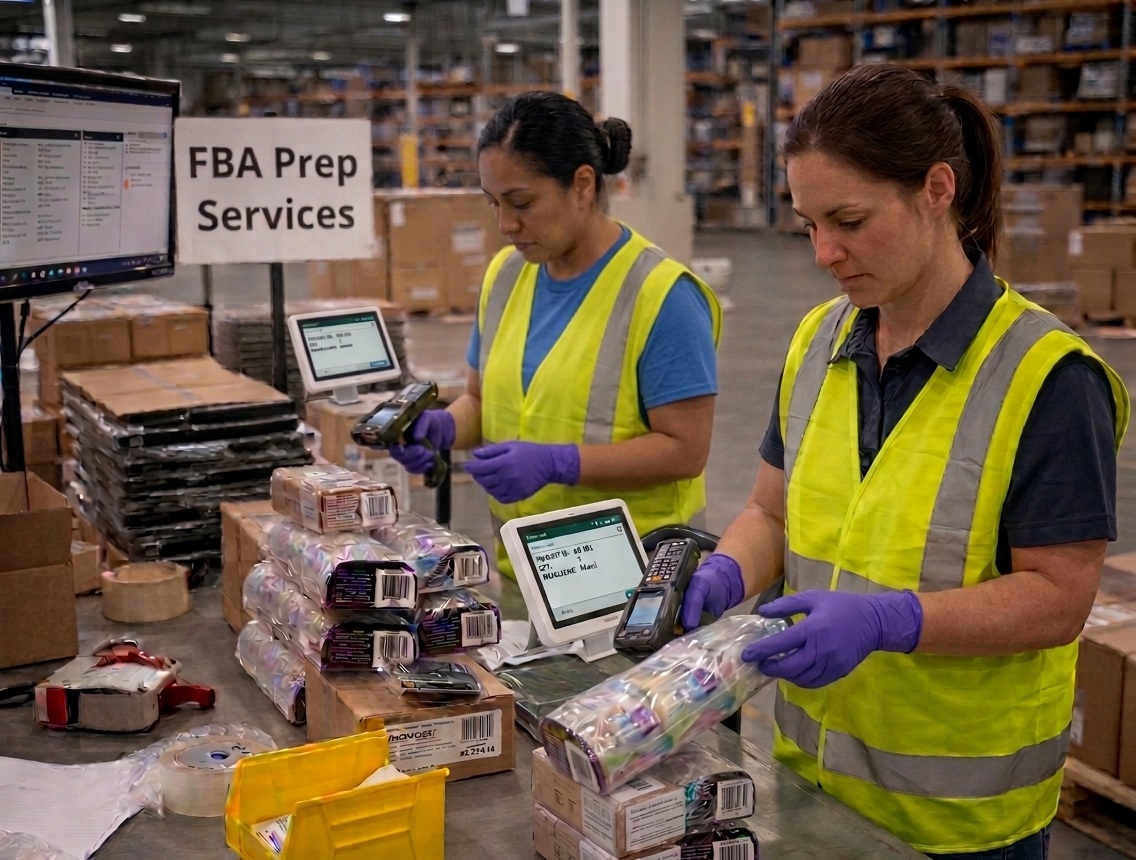
Poly-bagging with suffocation warnings, bubble wrapping, fragile labels, set creation labels, "sold as set" stickers, expiration labels, box-level content labels, and pallet-level prep — every prep type executed exactly per Amazon's current Prep Requirements Guide. Compliance verified at the unit level before any shipment leaves our facility.
📋
We create your Amazon shipment plans in Seller Central, distribute inventory to the correct receiving FCs based on Amazon's routing, generate carrier labels per box, and reduce the admin burden of FBA inbound to a single approval click on your end.
🔄
Prep FBA inventory, fulfill FBM orders, and ship DTC orders from the same warehouse, drawing from a shared inventory pool. When FBA inventory depletes, FBM coverage continues automatically without the duplicate-stock problem of running separate operations. One inventory pool, every channel.
🌍
Our Los Angeles facility sits 8 miles from the Ports of Los Angeles and Long Beach — where roughly 40% of all U.S. ocean freight enters. Brands importing direct from overseas manufacturers cut 5-7 days and $4,000-$8,000 per container in inland drayage cost versus prepping at a Midwest or East Coast facility.
Whether you send one pallet a month to FBA or a full container every week, our prep capacity scales with your replenishment cycle.
Sellers who need consistent FBA prep but lack the warehouse space, trained staff, prep supplies, or time to handle it in-house — and refuse to risk FC rejections by cutting corners on Amazon's prep requirements.
Sellers new to FBA who need guidance on Amazon's Prep Requirements, shipment plan creation, FC routing logic, and the operational realities of FBA inbound — not just a vendor that quotes a per-unit prep fee without explaining what they're doing.
Amazon enforces strict prep requirements for every FBA inbound shipment. Products that arrive at fulfillment centers without correct prep are rejected, returned at your expense, or in some cases destroyed. Amazon does not make exceptions for "close enough." Even minor errors — a missing suffocation warning sticker, an FNSKU label applied 1mm over the manufacturer barcode, an incorrect box-level content count, a polybag without the required transparency, a set without "sold as set — do not separate" labeling — can trigger an FC rejection that locks your inventory in receiving for weeks while Amazon investigates.
3PLCity follows Amazon's Prep Requirements Guide exactly, with prep workflows updated whenever Amazon revises the guide. Our prep staff are trained on every category — poly-bagging, FNSKU labeling, bubble wrapping, set creation, fragile items, expiration date labeling, box-level content labeling, pallet assembly, and the seller-prepped versus Amazon-prepped category distinctions that determine which products require which prep steps. Compliance is verified at the unit level before any shipment leaves our facility, and our zero FC rejection rate means your inventory hits Amazon's shelves on schedule, every shipment.
Most FBA sellers import from overseas manufacturers — predominantly China, Vietnam, Bangladesh, and India. Your containers arrive at the Ports of Los Angeles and Long Beach before they go anywhere else in the country. Roughly 40% of all U.S. ocean freight enters through these two ports. Our Gardena facility sits 8 miles from the ports — we receive containers directly via local drayage, cutting $4,000-$8,000 per 40-foot container in cross-country trucking cost and 5-7 days of inland transit time compared to prepping at a Midwest or East Coast warehouse.
For high-volume sellers, this geographic advantage compounds. A brand shipping 20 containers per year saves $80,000-$160,000 in drayage cost alone by prepping in LA versus the Midwest. The same brand cuts roughly 100-140 days of cumulative inland transit annually — time that translates directly into faster inventory turn, less working capital tied up in transit, and faster response to demand changes. For brands sourcing from Asia, port-adjacent FBA prep is not just convenient — it's a material cost advantage.
Every brand that switches to 3PLCity from another prep vendor or in-house FBA prep arrives with the same set of recurring problems. FNSKU labels missing entirely or applied over the wrong manufacturer barcode, triggering commingling risk. Poly-bags without the required suffocation warning sticker. Multi-piece sets not marked with "sold as set — do not separate" labels. Insufficient bubble wrap or padding on fragile items. Box-level content labels with incorrect X-of-X counts that don't match the shipment plan. Pallets not meeting Amazon height, weight, or shrink-wrap requirements. Shipment plan discrepancies — wrong quantity, wrong FC, wrong carrier. Expiration-dated products without compliant date labeling. Liquid or leak-prone products without secondary containment.
Every one of these errors triggers an FC rejection or a chargeback. 3PLCity prevents all of them at the source through documented prep workflows, scan-verification at every step, and prep staff trained against Amazon's current Prep Requirements Guide. Our zero FC rejection rate isn't marketing language — it's the operational outcome of a prep process designed to eliminate the specific failure modes that destroy FBA seller P&Ls.
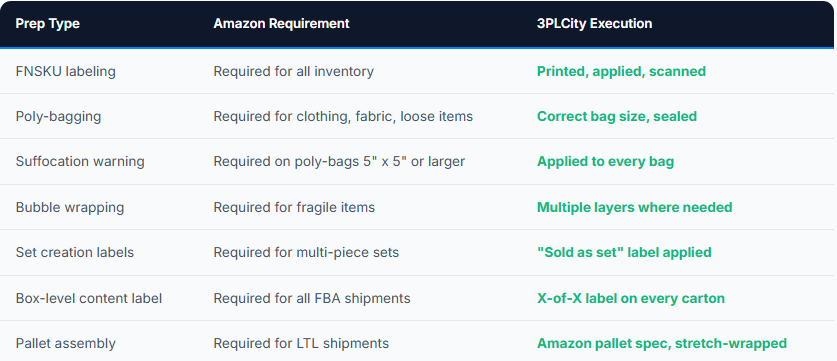
FNSKU (Fulfillment Network Stock Keeping Unit) is Amazon's proprietary barcode that identifies your specific listing within Amazon's fulfillment network. It must be applied over the manufacturer's UPC or EAN barcode on every unit before the shipment can be received at an FC. Without correct FNSKU labeling, Amazon cannot track your inventory separately from other sellers selling the same product, and may commingle your units with other sellers' stock — which means a customer might receive a counterfeit unit shipped under your brand name and you take the blame for the negative review.
Amazon requires poly-bagging for clothing, fabric items, plush toys, and any product with multiple components that could separate during transit. Items vulnerable to dust, moisture, or contamination also require poly-bagging. Every poly-bag must be transparent enough for FC staff to identify the product without opening, must be sealed (not just folded), and must carry a suffocation warning sticker if the bag opening is 5 inches or larger. We follow every requirement exactly — missing a suffocation sticker on a single unit is one of the most common reasons FBA shipments get rejected at receiving.
Standard prep completes within 24-48 hours from inbound receipt at our facility. For very large shipments, complex prep requirements, or unusual product types, we schedule capacity in advance — usually requiring 48 hours of advance notice. Rush prep is available for time-sensitive replenishment, Lightning Deals, Prime Day, Q4 inbound, or product launches with same-day or next-day turnaround at expedited rates. There is no prep backlog at our facility — units are processed in order of arrival, not held in queue waiting for capacity.
Yes to both. We have access to your Seller Central account on a permission-controlled basis, create shipment plans for each prep run, distribute inventory to the correct fulfillment centers based on Amazon's routing logic, generate the carrier label for each box, and stage everything for your approval before dispatch. Amazon Partnered Carrier rates (typically UPS Ground or USPS for small parcel) are significantly discounted for FBA inbound and are our default for box shipments under 150 lbs total. For pallet-level shipments, we coordinate LTL freight with Amazon-approved carriers including pallet building to Amazon spec, BOL creation, and carrier appointment scheduling.
Yes to both. Send a large initial shipment — a full container, multiple pallets, or bulk inbound from your manufacturer — and we prep batches as needed for your FBA replenishment schedule. Unprepped inventory and FBA-ready inventory are tracked separately in our WMS so you always see both pools. We also fulfill DTC orders, B2B wholesale orders, and TikTok Shop orders from the same shared inventory pool — when FBA inventory depletes, FBM coverage continues automatically, eliminating the duplicate-stock waste of running separate channel-specific operations.
Because your inventory probably arrives at the Ports of Los Angeles or Long Beach. Roughly 40% of all U.S. ocean freight enters through these two ports — and if you source from China, Vietnam, India, Bangladesh, or anywhere in Asia, your containers land minutes from our facility. Prepping at a Midwest warehouse means paying $4,000-$8,000 per container in cross-country drayage and waiting 5-7 additional transit days before prep even begins. A high-volume seller shipping 20 containers per year saves $80,000-$160,000 in drayage cost and 100+ days of cumulative inland transit by prepping in LA versus inland. Port-adjacent FBA prep is a material cost advantage for any brand sourcing from overseas.