High-volume pick-and-pack, retail-ready pallet building, GS1 barcode compliance, multi-pack bundling, and true omnichannel fulfillment from one inventory pool — shipped from our Los Angeles fulfillment center for consumer packaged goods brands selling DTC, on Amazon, and into retail accounts across food, beverage, household, personal care, and packaged goods.

Built for scale
Retail-ready compliance
One inventory pool
Rotation standard

CPG inventory inbound by container, LTL, or full truckload via container drayage from the Ports of Los Angeles and Long Beach — we are 8 miles from the ports. Case packs counted and verified, lot numbers and expiration dates captured at receipt for food and consumable products, pallet condition inspected before stock enters inventory.

Inventory stored by SKU, lot, and case-pack configuration. Naturally cool Los Angeles warehouse environment ideal for food, beverage, and temperature-sensitive CPG without artificial climate control. FIFO rotation maintained at the lot level. High-velocity SKUs positioned near pack-out stations to maximize throughput on high-volume orders.

Orders sync in real time from every channel — Shopify and DTC, Amazon FBM and FBA replenishment, Walmart, TikTok Shop, and EDI wholesale POs. Our WMS allocates inventory from one shared pool with real-time channel allocation, preventing oversells between DTC demand and committed retail purchase orders.

DTC orders picked and packed individually with branded packaging. Retail wholesale orders built into case packs and pallets per routing guide specification — GS1-128 carton labels, mixed-SKU pallet rules, stack heights, and shrink wrap all to retailer spec. Multi-pack bundling and kitting handled for value packs and retail assortments.

DTC orders ship via multi-carrier rate-shopped parcel. Retail orders ship via LTL or FTL freight with routed carriers per retailer routing guide, BOL creation, ASN transmission, and appointment scheduling. Amazon-bound replenishment ships via Amazon Partnered Carrier or LTL freight to FCs.

Real-time inventory, order, and channel performance visibility. SKU-level velocity reporting, low-stock and reorder alerts, expiration aging reports for food CPG, and chargeback tracking for retail accounts. The data you need to manage replenishment across every channel from one dashboard.
CPG runs on volume. Our operation is built for high-throughput pick-and-pack — high-velocity SKU positioning, batch picking, and pack-out workflows designed to move thousands of orders per day without sacrificing the 99.8% accuracy that protects your brand and your retailer scorecards.
Retail wholesale orders built to retailer specification — GS1-128 carton labels, case-pack configurations, mixed-SKU pallet rules, pallet stack heights, shrink wrap standards, and pallet labeling per Target, Walmart, Costco, Kroger, Whole Foods, and regional grocery routing guides. Retail-ready means it passes the retailer's dock without a chargeback.
🔄DTC, Amazon, Walmart, TikTok Shop, and retail wholesale fulfilled from one shared inventory pool with real-time allocation. No duplicate stock split across separate operations, no overselling between channels, no working capital wasted on safety stock in five different places. One pool, every channel.
🏷️Retail accounts require GS1-standard barcodes — UPC-A on units, GS1-128 on cases and pallets, SSCC pallet labels for ASN matching. We apply, verify, and manage GS1-compliant labeling so your retail shipments scan correctly at the retailer's distribution center and don't bounce back as compliance failures.
⏱️Food, beverage, and consumable CPG products carry expiration dates. FIFO rotation enforced at the WMS level ships oldest stock first. Expiration dates tracked from receipt, with aging inventory flagged before it becomes a write-off or a retailer rejection for short-dated product.
📡EDI 850, 856, and 810 transactions for retail trading partners. Routing guide compliance maintained per account. ASN transmission ahead of deadlines, BOL creation, and appointment scheduling. The wholesale operational discipline that keeps your retail accounts profitable instead of chargeback-eroded.
CPG fulfillment is defined by two characteristics that most generalist 3PLs struggle to handle together: high volume and channel duality. Consumer packaged goods brands ship more units than almost any other ecommerce category — high order counts, multi-unit orders, case packs, and retail pallets — at margins thinner than fashion, beauty, or electronics. Pick-and-pack efficiency is not a nice-to-have; it is the difference between a profitable CPG operation and an unprofitable one.
At the same time, CPG brands almost always sell through multiple channels at once — DTC on their own website, Amazon, sometimes Walmart and TikTok Shop, and increasingly retail wholesale into grocery and big-box. Each channel has different fulfillment requirements: DTC needs branded parcel shipping, Amazon needs FBA prep or FBM fulfillment, and retail needs GS1-compliant pallets built to routing guides. A 3PL that handles DTC well but botches retail compliance, or runs retail well but treats DTC as an afterthought, costs CPG brands money on every order. 3PLCity runs both from one inventory pool with the volume capacity CPG demands.
The biggest operational mistake CPG brands make with fulfillment is splitting inventory across separate operations — one 3PL or warehouse for DTC, another for Amazon, another for retail wholesale. Split inventory means duplicated safety stock tying up working capital, oversells when one channel's demand spikes and the inventory is allocated elsewhere, manual reconciliation across disconnected systems, and no single source of truth for what you actually have.
3PLCity fulfills every channel from one shared inventory pool. When a DTC order comes in on Shopify, a customer order on Amazon, a TikTok Shop sale, and a wholesale PO from Kroger, all four draw from the same physical inventory with real-time allocation. When a retail PO is confirmed, that committed inventory is reserved and removed from DTC and Amazon availability automatically — preventing the oversell that damages retailer relationships and customer trust. One pool means less working capital tied up in stock, no overselling, and one accurate real-time view of inventory across your entire business.
CPG supply chains are import-heavy — packaged foods, beverages, household goods, and personal care products and their components flow in from overseas manufacturing, arriving at the Ports of Los Angeles and Long Beach. Our facility sits 8 miles from the ports, receiving containers and full truckloads directly via local drayage. For high-volume CPG brands moving large quantities of inventory, the drayage savings alone — $4,000-$8,000 per 40-foot container versus shipping to an inland warehouse — compound into substantial annual savings.
From Los Angeles, CPG brands reach the entire West Coast in 1-2 days and 96% of the U.S. population in 2 business days via ground. For CPG brands shipping wholesale to West Coast grocery and big-box distribution centers — Costco, Kroger-owned chains, regional grocers across California, Oregon, Washington, Arizona, and Nevada — LA fulfillment dramatically cuts both freight cost and transit time. The naturally cool Los Angeles warehouse environment also benefits food, beverage, and temperature-sensitive CPG products, providing stable storage conditions without artificial climate control.
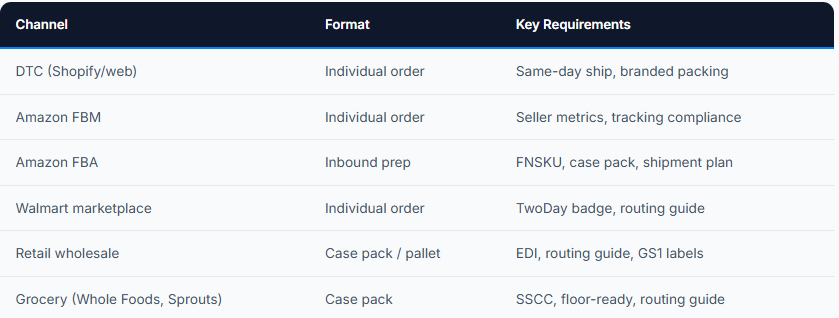
Yes — this is the core of CPG fulfillment. We maintain one shared inventory pool that serves DTC orders (Shopify, your website, TikTok Shop), Amazon (FBM fulfillment and FBA replenishment prep), Walmart, and retail wholesale POs simultaneously, with real-time allocation across every channel. When a retail PO is confirmed, the committed inventory is reserved and removed from DTC and marketplace availability automatically, preventing oversells. One pool eliminates the duplicate safety stock, working capital waste, and reconciliation headaches of running separate channel operations.
GS1 is the global standard for retail barcodes — UPC-A barcodes on individual units, GS1-128 barcodes on cases, and SSCC labels on pallets that retailers scan to match against your ASN. Retail accounts require GS1-compliant labeling, and shipments that don't scan correctly at the retailer's distribution center get rejected or chargebacked. We apply, verify, and manage GS1-compliant barcodes on units, cases, and pallets so your retail shipments pass the dock cleanly.
Yes. Our operation is built for high-throughput fulfillment — high-velocity SKU positioning near pack-out stations, batch picking workflows, and pack-out processes designed to move thousands of orders per day. CPG runs on volume at thin margins, so we optimize pick-and-pack efficiency without sacrificing the 99.8% accuracy that protects your brand and your retail scorecards. Whether you ship 5,000 orders a month or 500,000, the operation scales.
Yes. Food, beverage, and consumable CPG products are received with lot numbers and expiration dates captured at the unit or case level. FIFO rotation is enforced at the WMS level so oldest stock ships first. Expiration dates are tracked continuously, with aging inventory flagged before it becomes a write-off or gets rejected by a retailer for being short-dated. Our facility is FDA-registered for food and beverage handling, and the naturally cool LA warehouse environment provides stable storage conditions.
Yes. We maintain a routing guide compliance library for retail accounts — Target, Walmart, Costco, Kroger, Whole Foods, and regional grocery and big-box chains. We process EDI 850, 856, and 810 transactions, build pallets to each retailer's specification, transmit ASNs ahead of deadlines, create BOLs, and schedule delivery appointments. Compliance is verified before any retail shipment leaves the dock, which is how we keep CPG brands' chargeback rates near zero.
Food and beverage brands, household goods brands, personal care CPG, emerging DTC-to-retail brands, established CPG brands switching 3PLs, and multi-pack/club-store brands. CPG supply chains are import-heavy, with products and components arriving at the Ports of Los Angeles and Long Beach. Our facility 8 miles from the ports receives containers and full truckloads directly, saving $4,000-$8,000 per container in drayage versus inland warehousing. From LA, CPG brands reach the West Coast in 1-2 days and 96% of the US in 2 days — and the naturally cool warehouse environment benefits food and temperature-sensitive CPG.